
AMX NMX-ATC-N4321D-C AMX N4321D Audio Transceiver Card, Dante audio ov
Description
AMX NMX-ATC-N4321D-C Audio Transceiver Card
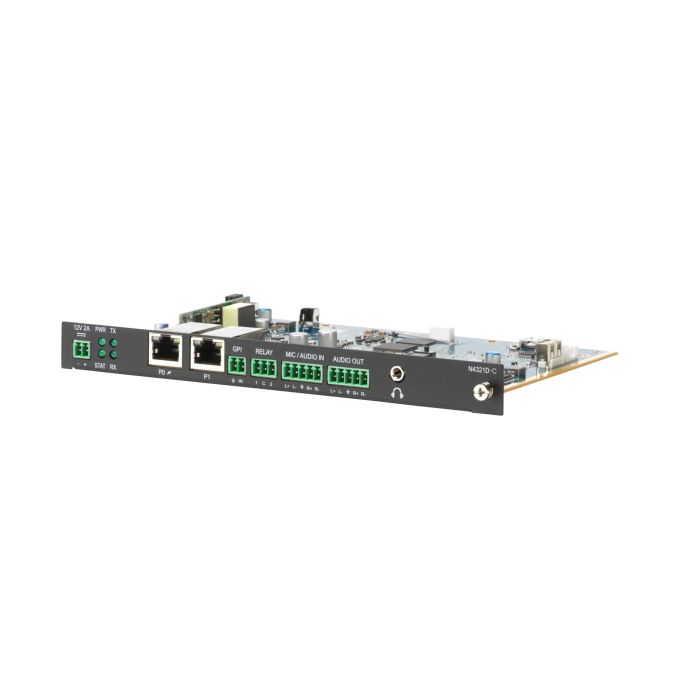
The N4321D is a compact, rack-mountable audio interface card that brings networked audio distribution into your venue or event space. This card slots directly into AMX control systems and handles Dante audio-over-IP conversion with minimal latency, making it reliable for live sound setups, permanent installations, and broadcast environments where you need dependable, standards-compliant audio routing without surprises.
Network Audio Architecture
Built around dual Gigabit Ethernet ports with auto-sensing capability, the N4321D gives you flexible network connectivity with one port supporting PoE+ power delivery, so you can eliminate separate power runs in many installations. Support for Dante, AES67, and streaming PCM protocols means you can integrate it with industry-standard networked audio gear and layer it into existing systems without compatibility headaches.
Audio I/O Configuration
The card delivers flexible routing with 2-channel balanced/unbalanced audio inputs, 2-channel Dante and AES67 inputs, and 8-channel PCM audio inputs on the input side. Output options include 2-channel balanced audio via 5-pin phoenix connector, 2-channel Dante/AES67 outputs, 8-channel PCM outputs, and a 2-channel unbalanced headphone jack, so you can adapt it to multiple analog and digital pathways across your audio network.
Key Features
- 2-channel balanced and unbalanced analog audio inputs
- 2-channel Dante/AES67 audio inputs
- 8-channel PCM audio inputs
- 2-channel balanced audio output (5-pin phoenix connector)
- 2-channel Dante/AES67 audio outputs
- 8-channel PCM audio outputs
- 2-channel unbalanced audio output (headphone jack)
- Dual auto-sensing Gigabit Ethernet ports
- PoE+ power delivery support on one Ethernet port
- 16-bit analog-to-digital conversion at 32 kHz, 44.1 kHz, and 48 kHz
- UL2043 plenum space certification
The N4321D combines standards-compliant Dante networking with comprehensive I/O flexibility, making it a solid workhorse for sound engineers and integrators running networked audio in live and installed environments.
More Information
| Condition | New |
|---|
Reviews
At a Glance
The AMX N4321D is a professional-grade audio transceiver card that converts Dante audio-over-IP signals for integration into large venues, broadcast facilities, and corporate AV systems. Built for sound engineers and system integrators who need reliable, low-latency networked audio routing across multiple protocol standards (Dante, AES67, PCM), it slots directly into AMX control systems and eliminates separate power infrastructure through PoE+ delivery. Choose this card when you're deploying networked audio in a controlled venue or broadcast environment where standards compliance and seamless multi-protocol integration are non-negotiable.
Who This Is For
Great for
- ✓ Live Performance
- ✓ Studio Sessions
- ✓ Broadcast
- ✓ Corporate AV installations
Not the best pick for
- – Home Recording
- – Practice
- – Small venues
Skill level: Professional
Frequently Asked Questions
What audio protocols does the N4321D support?
The card supports Dante, AES67, and streaming PCM protocols, ensuring compatibility with industry-standard networked audio ecosystems and seamless integration with existing installations.
What are the analog and digital I/O options?
Inputs include 2-channel balanced/unbalanced analog audio, 2-channel Dante/AES67, and 8-channel PCM. Outputs include 2-channel balanced audio via 5-pin phoenix connector, 2-channel Dante/AES67, 8-channel PCM, and a 2-channel unbalanced headphone jack.
Does the N4321D require separate power conditioning?
No—one of the two Gigabit Ethernet ports supports PoE+ power delivery, eliminating the need for separate power infrastructure in most installations.
What sample rates and bit depth does it support?
The card features 16-bit analog-to-digital conversion at 32 kHz, 44.1 kHz, and 48 kHz.
Is this card suitable for small venues or home studios?
No—the N4321D is designed for large-scale professional venues, broadcast facilities, and corporate AV installations where networked audio routing and standards compliance are essential; it is not recommended for home recording or small-venue applications.