
BSS BLU-326 Networked I/O expander B-Stock
 Share
Share
In stock
Only 1 left
- SKU
- BSSBLU326M-US-B
 .
. Description
BSS BLU-326 Networked I/O Expander B-Stock
The BSS BLU-326 is a professional-grade networked audio interface built for live sound, broadcast, and installed systems that demand scalable, fault-tolerant connectivity across distributed networks. This B-Stock unit carries the same robust architecture and full feature set as new stock at a reduced price point, making it an excellent value for sound engineers and system operators deploying Dante-networked audio infrastructure in touring rigs, permanent venues, and broadcast facilities.
Network Architecture & Connectivity
Built around a 256-channel, low-latency digital audio bus with dual Dante/AES67 ports, the BLU-326 delivers fault-tolerant redundancy across standard Category 5e cabling up to 100 meters—distances extending beyond 40km with fiber optic media converters. Four hot-swappable card slots accommodate mixed configurations of analog inputs, analog outputs, digital inputs, and digital outputs in banks of four, supporting up to 16 analog inputs, 16 digital inputs, 16 AEC inputs, 16 analog outputs, 16 digital outputs, plus 4 telephone connections along with 12 control inputs and 6 logic outputs.
Audio I/O Specifications & Control
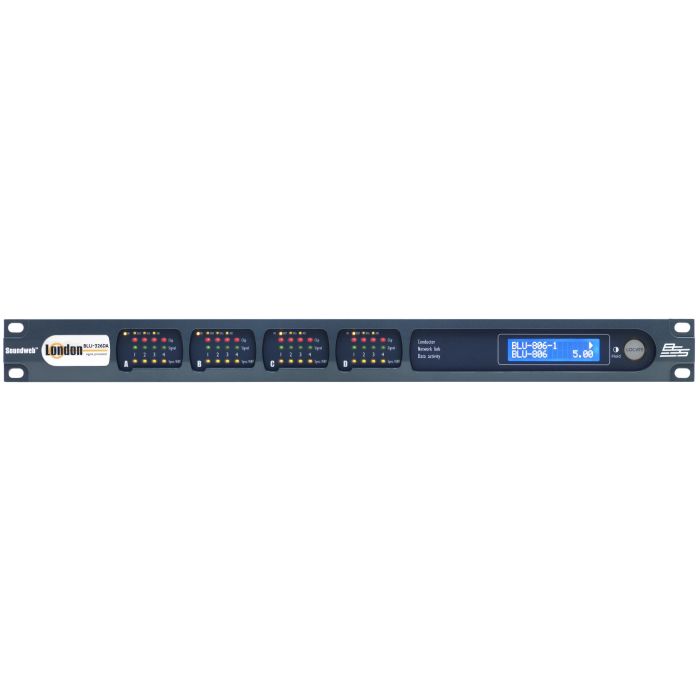
Analog inputs feature electronically balanced Phoenix Combicon connectors with software-configurable gain from 0dB to +48dB in +6dB steps, 3.5kΩ input impedance, maximum input level of +20dBu at 0dB gain, and per-channel 48V phantom power selection. Digital inputs accept AES/EBU or S/PDIF signals on removable screw connectors with sample rate conversion covering 8kHz–96kHz, and the entire system configures through HiQnet Audio Architect software with drag-and-drop interface control, while a front-panel display shows device name, type, firmware, IP address, and subnet mask.
Key Features
- 19" single rack space form factor
- Dual Dante/AES67 ports for redundant networked audio
- 256-channel, low-latency digital audio bus
- Four hot-swappable I/O card slots for mixed analog and digital configurations
- Up to 16 analog inputs with gain switching 0dB to +48dB in +6dB steps
- Up to 16 analog outputs, 16 digital inputs, 16 digital outputs, 16 AEC inputs
- 12 control inputs and 6 logic outputs for automation and integration
- Sample rate conversion from 8kHz to 96kHz on digital inputs
- Per-channel 48V phantom power on analog inputs
- 100-meter Dante reach with fiber optic extension beyond 40km
- EN 54-16 compliant for life safety applications
- Full configuration via HiQnet Audio Architect software with front-panel display
The BLU-326 delivers enterprise-class audio networking reliability and scalability for live reinforcement, broadcast, and installed sound applications requiring transparent integration with modern Dante infrastructures.
This specific B-Stock unit features minor cosmetic imperfections: light blemishes and surface scratches on the chassis exterior acquired during storage or transit. These marks are purely superficial and have absolutely zero impact on the networking functionality, audio performance, or structural integrity of the unit. Acquire this premium BSS networked I/O expander at a significant B-Stock discount while maintaining full manufacturer warranty coverage and complete operational reliability.
More Information
| Condition | Refurbished |
|---|---|
| Country of Manufacture | Malaysia |
Reviews
At a Glance
The BSS BLU-326 is a professional networked audio I/O expander built on Dante/AES67 infrastructure, delivering 256 channels of low-latency audio with fault-tolerant redundancy across Category 5e cabling and beyond. Sound engineers and integrators running complex installed systems—broadcast facilities, large venues, touring productions—rely on it for transparent, enterprise-class connectivity that scales from analog and digital I/O to full networked audio control. This B-Stock unit offers the same robust architecture and feature set at a reduced price, with only minor cosmetic imperfections and full operational reliability.
Who This Is For
Great for
- ✓ installed sound
- ✓ broadcast
- ✓ live reinforcement
- ✓ networked audio infrastructure
Not the best pick for
- – home recording
- – small venues
- – practice spaces
Skill level: Professional
Frequently Asked Questions
What does B-Stock mean for this unit?
B-Stock means this BLU-326 is fully functional with the same robust architecture and feature set as new stock, but carries minor cosmetic imperfections such as light blemishes and surface scratches on the chassis exterior from storage or transit. These marks are purely superficial and have zero impact on networking functionality, audio performance, or structural integrity. Full manufacturer warranty coverage and complete operational reliability are included.
What is the Dante connectivity and reach on this unit?
The BLU-326 features dual Dante/AES67 ports for fault-tolerant redundancy with a standard reach of up to 100 meters over Category 5e cabling. Using fiber optic media converters, the Dante network can extend beyond 40km, making it suitable for large distributed installations and broadcast facilities.
What I/O configurations are supported?
Four hot-swappable card slots accommodate mixed analog, digital, and control configurations. The unit supports up to 16 analog inputs, 16 analog outputs, 16 digital inputs, 16 digital outputs, 16 AEC inputs, 4 telephone connections, 12 control inputs, and 6 logic outputs. Analog inputs feature electronically balanced Phoenix Combicon connectors with software-configurable gain from 0dB to +48dB in 6dB steps and per-channel 48V phantom power.
Is this unit suitable for broadcast and life safety applications?
Yes, the BLU-326 is EN 54-16 compliant for life safety applications and is designed for installed sound, broadcast, and live reinforcement environments requiring enterprise-class audio networking reliability and scalability. It is not suitable for small venues, practice spaces, or home recording applications.
How is the BLU-326 configured and controlled?
Full configuration occurs through HiQnet Audio Architect software with a drag-and-drop interface control, and a front-panel display shows device name, type, firmware, IP address, and subnet mask. Digital inputs include sample rate conversion covering 8kHz–96kHz, enabling integration with mixed audio sources across networked infrastructure.
Do I pay sales tax on this order?
We collect sales tax only on orders shipped to California. Orders shipped to any other US state are charged $0 sales tax at checkout when you buy direct from our website. On this item that is roughly $162 less out the door than the same listed price at a national retailer or on a marketplace. Marketplaces such as eBay, Reverb and Amazon collect sales tax in nearly every state as marketplace facilitators no matter who the seller is, so the same item at the same price costs less bought direct. Free US shipping and 30-day returns are included. Some states ask buyers to self-report use tax on out-of-state purchases.
Similar Gear
Complete the Rig
Gear that pairs well with this.
✨ For You
Based on what you've been looking at.